Still Here, In The Corner Room
Acronyms used: United States [US, the country where I once worked and built another version of my life]; Search Engine Optimization [SEO, the practice of making writing easier for search engines and readers to discover]; Artificial Intelligence [AI, software systems that imitate or automate parts of human reasoning, pattern recognition, and language].
Some people leave countries. I have become unable to leave my own room.
That sounds theatrical, like something a tragic uncle might say after two pegs too many at a wedding, while the fish fry cools and the younger generation avoids eye contact. But it is not theatre. It is just the present address of the soul. I had thought I would leave India after ten years of self-inflicted incarceration, that I would pack a suitcase, revive the old passport dreams, and return to the other life, the American corridors, the professional rooms, the clean pavements where a man could pretend his future still had buttons and switches. I did not leave. I am not leaving. I cannot.
I am still here.
Not heroically. Not like those inspirational men who fall, rise, fall again, rise again, and then sell the story in a hardback with a smiling author photo. I am here in the more ordinary way a cracked plastic chair remains on a balcony through three monsoons because nobody has the energy to throw it away. I had plans once. Big ones, small ones, foolish ones, practical ones. They did not explode. They expired. There is a difference. Explosion gives drama. Expiry gives smell.
The only thing that still feels completely mine is the depression. This is a terrible thing to own. It is like inheriting a locked trunk full of wet clothes. You cannot wear them. You cannot sell them. You cannot explain them to guests. You simply know they are there, growing heavier in the corner. Inside me it feels less like sadness and more like a dead electrical line running through the walls. Something was meant to light up. It does not. You tap the switch. Nothing. You tap again, because human beings are fools and hope is mostly repetition with better manners. Still nothing.
And yet the thing consumes. That is the strange part. A deadness that eats.
The black hole is not a poetic exaggeration. It is a working model. Desire falls in. Morning falls in. A decent cup of tea falls in. Someone says, “You should go out more,” and the sentence also falls in, taking with it the face of the person who said it. Ambition, affection, irritation, hunger, vanity, curiosity—all of them approach the edge, wave briefly, and vanish without paperwork. I sit there like the junior clerk of my own disappearance.
Outside, Calcutta continues its daily circus. The vegetable seller shouts as if pumpkin pricing is a constitutional crisis. A motorbike coughs like an old tuberculosis patient. Somewhere a pressure cooker whistles with the moral certainty of a Supreme Court judgment. The news on the phone mutters about oil, elections, wars, heat, markets, AI, some billionaire’s new miracle, some politician’s old fraud wearing a fresh kurta. The world is busy, sweaty, noisy, full of opinions, and somehow very confident for a planet that has mislaid the plot several times before lunch.
I am not confident.
I am comfortable only alone. That line worries people, because loneliness is supposed to be the disease and company the medicine. But company often feels to me like applying chilli powder to scraped skin. People arrive with expectations. They bring questions, cheerfulness, suspicion, advice, invitations, family news, success stories, thinly wrapped comparisons, and that dreadful social brightness which says: perform normality now, please. I can do it for a while. I can nod. I can smile. I can ask after someone’s son in Bangalore or daughter in Toronto. I can pretend to be a functioning citizen with opinions on water filters and mutual funds.
Then something inside coils back.
It is physical. The body becomes a snail receiving bad intelligence. The face closes. The words dry up. The room grows loud. Even kindness becomes too much if it arrives with shoes on. I return to my shell, which is not a noble retreat but a survival method. Some men meditate in silence. Some men conquer boardrooms. I sit on the sofa in the shanty boondocks of the city, listening to the ceiling fan chop the afternoon into useless pieces.
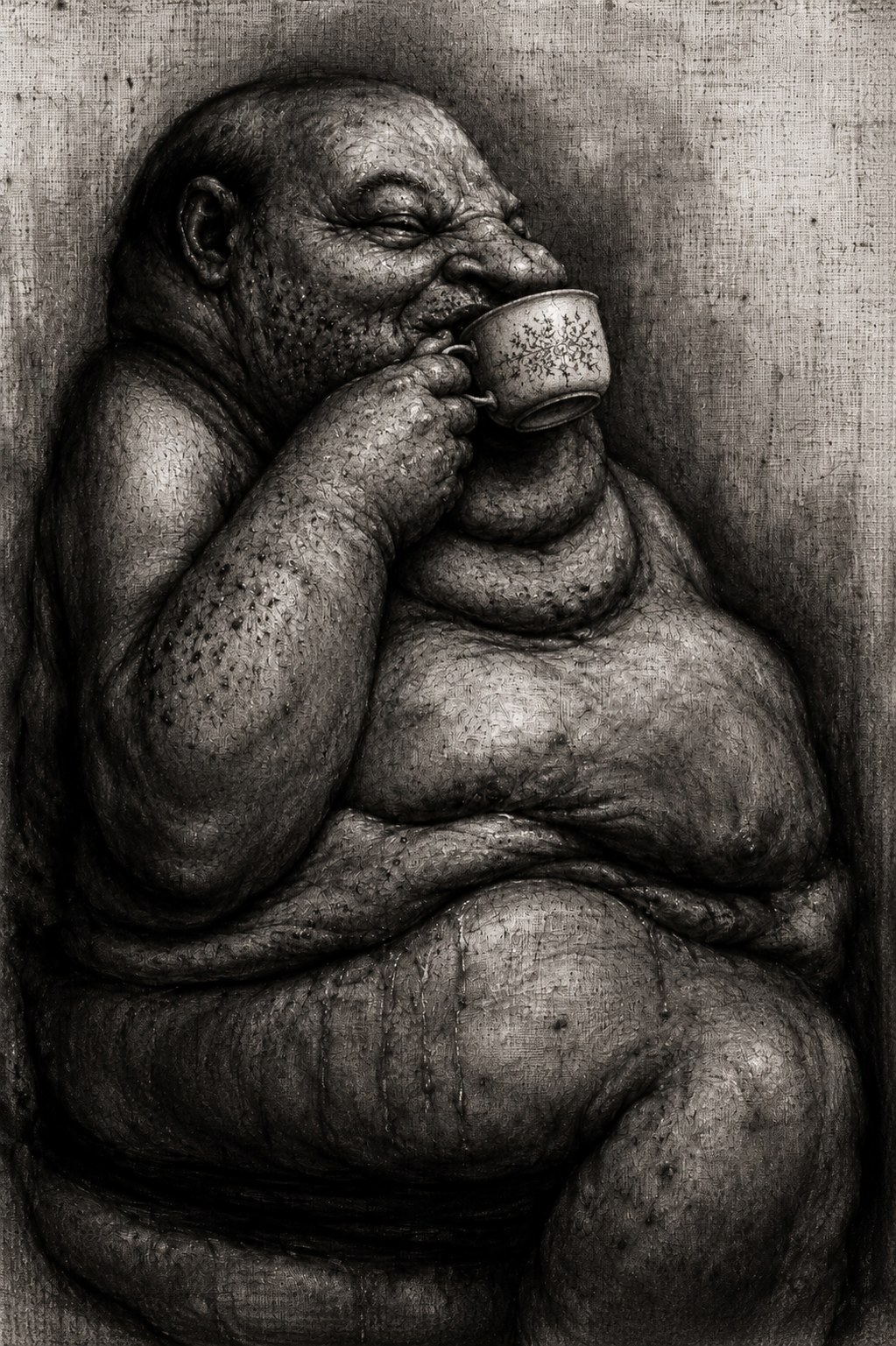
There, at least, I can think my own thoughts. Demented, squirrelly, ghoulish thoughts, yes, but mine. I scribble. I sketch. I let the skull-fillings rattle. I draw the creatures that visit the mind when the respectable parts of the day have gone out to buy milk. This is the only freedom I know now: the freedom of being unobserved. Not celebrated. Not improved. Not optimized. Merely left alone long enough to hear the machinery inside, even if the machinery sounds like a tramcar full of bones.
A strange confession: depression is sometimes more trustworthy than happiness. Happiness is a guest with perfume and luggage. It arrives making promises. It says, “This time I may stay.” It rarely does. Depression is rude, but punctual. It does not flatter. It does not decorate the room. It sits on the edge of the bed like an old tax inspector and says, “We both know the accounts are bad.”
People think withdrawal means hatred. Not quite. I do not hate humanity. I simply cannot afford too much of it at once. Humanity is best consumed in small doses, like pickle. Too much and the stomach protests.
There is also, if one is willing to be slightly wicked, a small consolation in failing. Ambition has done enough damage in this world. Every lane is jammed with men and women running after success like dogs behind a meat van. Some are talented. Some are lucky. Some are charming frauds. Some have teeth so polished they could guide aircraft. The world rewards the tireless, the flexible, the loud, the conveniently moral, and the amphibious creature who can swim through muck in the morning and give a leadership talk by evening.
I was never amphibious.
I was more like one of those old umbrellas that turn inside out in the first serious gust near Gariahat. Structurally present. Emotionally defeated. Not entirely useless, but requiring sympathy from the weather.
There was a time when I was in the game. Not winning, exactly, but on the field. I had work, movement, credentials, rooms where people discussed systems, data, hospitals, deadlines, and the hundred tiny disasters by which modern life keeps itself barely upright. The United States gave me a different version of myself. Not a glorious one. Let us not become drunk on memory. But a usable one. I could walk into professional spaces and not immediately feel like an illegal emotional immigrant. I had some evidence that I could still be of use.
Then life did that thing life does. It did not announce a catastrophe with violins. It simply removed one plank, then another, then another, until the bridge existed mostly in memory.
Now, when old acquaintances bleat gently about my unrealized potential, I feel a retro flashback of that former life. Their disappointment has a particular sound. Soft. Respectable. Almost kind. “You could have done so much.” “You had such ability.” “What happened?” As if I had misplaced a railway ticket. As if the old train were waiting at Howrah, steam rising, porter impatient, and I had failed to arrive because I was busy arguing with a biscuit.
What happened?
That is the question, isn’t it? Bengali families adore this question. It allows everyone to become a detective after dinner. Was it destiny? Was it temperament? Was it bad luck? Was it arrogance? Was it illness? Was it India? Was it America? Was it too much education and not enough cunning? Was it the stars, the genes, the economy, the father, the mother, the missed chance, the wrong friendship, the wrong year, the wrong city, the wrong wiring inside the skull?
The truthful answer is untidy.
I did not have enough of the practical animal in me. My father had some of this too, perhaps. A rigidness. A cheerlessness. A difficulty in becoming oily at the right moment. India is not only a country; it is an obstacle course designed by a committee of goats, clerks, gods nobody can prove, contractors, cousins, traffic police, and men who know a man who knows a man. To pass through it profitably you need many talents. You must flatter without shame, exaggerate without sweating, remember who must be invited, forget who must be paid, bend when required, grow extra hands, extra faces, extra explanations. The successful do not merely walk. They ooze, glide, crawl, leap, and reassemble.
I stood there like a square wooden block in a round plastic hole.
This is not moral superiority. That is the trap. Failed men often perfume their failure and call it integrity. I will not. Some of my collapse is illness. Some of it is temperament. Some cowardice. Some pride. Some lack of appetite for the daily theatre by which humans convert one another into ladders. Some plain fatigue. A man can be educated and still not be equipped. A man can understand many things and still not know how to live.
My mother, very old now, still carries the ghost of my possible life. She does not always speak it. She does not need to. Bengali mothers have a way of leaving half a sentence on the table like a covered bowl. You know what is inside. “If only…” “Maybe…” “You were…” The words do not finish because finishing them would be cruel. But the silence finishes them anyway.
She wonders, perhaps, whether destiny did this. I do not believe in divine bookkeeping, but I understand the appeal. Destiny is a soft cushion placed under hard facts. It allows families to avoid saying: this person did not adapt, this person broke, this person could not turn talent into livelihood, this person was not fit for the bazaar. Destiny turns poor wiring into cosmic fog. It is kinder. It is also less accurate.
Accuracy is overrated when the heart is old.
So I have made a smaller life, though “made” is too proud a verb. I have accepted a smaller perimeter. Room. Sofa. Corner. Tea. Notebook. Phone. Fan. A consulting income that arrives like a nervous relative, not enough to boast about, enough to postpone disaster. The day is not empty; it is filled with tiny negotiations. Should I answer this message? Should I cook rice? Should I read one article or stare at the wall? Should I open the window and let in air, mosquitoes, and the neighbor’s argument about school fees? Should I sketch the creature with the long neck or write about the man who became his own locked room?
There are worse lives. I know this. Knowing does not cure anything, but it prevents melodrama from becoming king. There are men sleeping under plastic sheets near railway tracks. There are women carrying entire households on their backs before breakfast. There are children doing homework beside drains with more determination than I have brought to anything in years. My suffering is not the largest suffering in the city. It is merely the one assigned to me.
That sentence helps a little.
Not much. A little.
I tell myself that stepping away from the race leaves more road for others. This is partly self-comfort, partly mischief. Let the ambitious run. Let the well-dressed rodents perform their Olympics. Let the cheerful frauds network under chandeliers. Let the flexible inherit the earth and then invoice it. I will sit here, unrequired, unpolished, watching the dust collect on the old trophies I never won.
But sometimes, in the late afternoon, when the light turns the color of weak tea and the city seems briefly less hostile, I remember wanting more. Not fame. Not the vulgar parade. Just a life that could be explained without comedy. A life that did not require footnotes. A life where my mother could have spoken of me without that small pause in the middle. A life where I did not feel like a leftover part from a machine nobody manufactures anymore.
That is the little knife.
Not failure itself. The memory of having once been possible.
Still, I remain. Barely, perhaps. Wastefully, perhaps. Annoyingly, if you are the sort who believes every human must become productive or be composted by Tuesday. I remain as a flicker remains in a candle-lit room when the power goes out: not enough to brighten the house, but enough to prove the dark has not yet finished its work.
I am still here.
For now, that is the whole autobiography.